Our philosophy
Teaching is human.
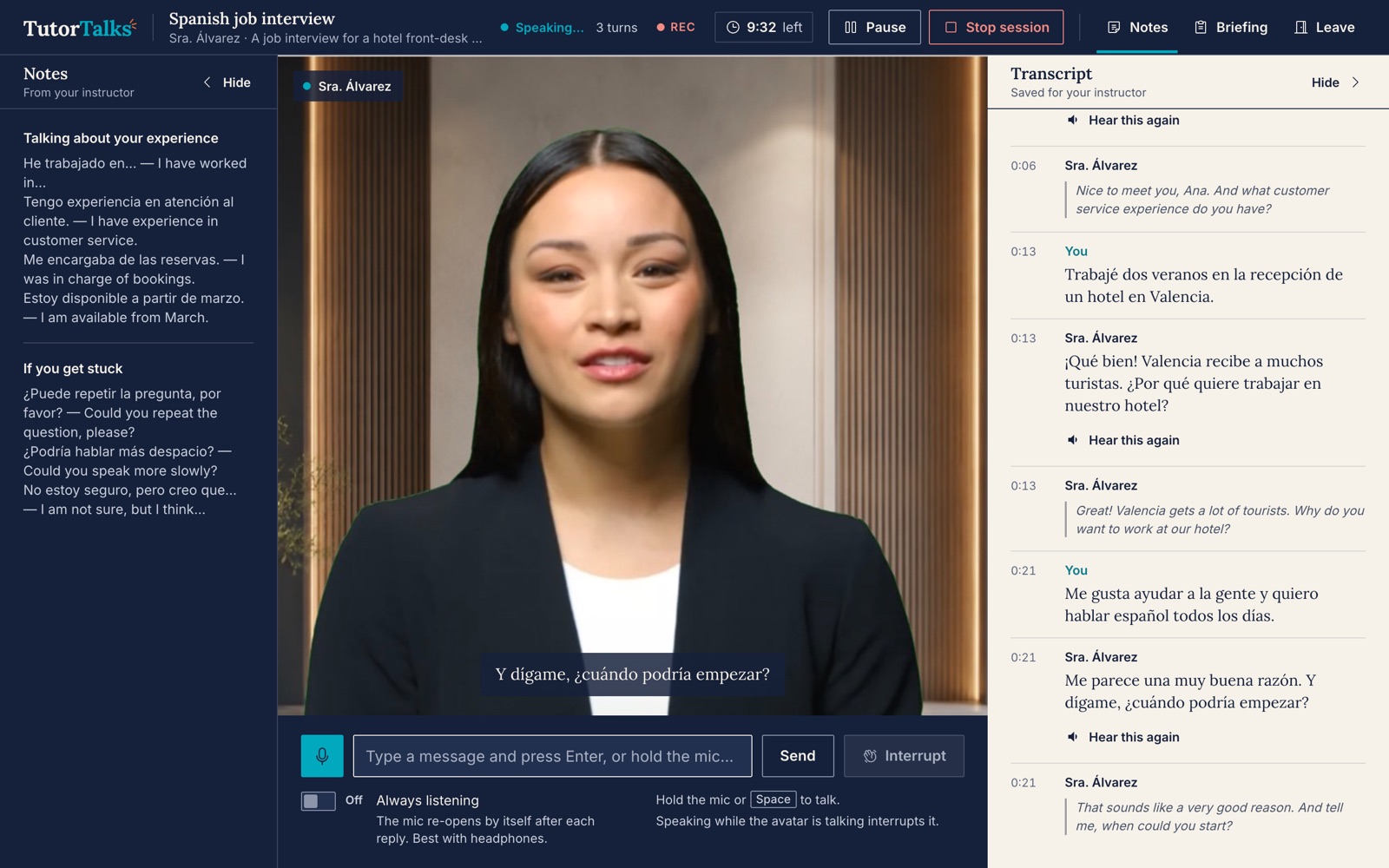
You know your students: what they’re working toward, where they’re stuck, and when they need a little encouragement. TutorTalks gives them a spoken practice partner for what you’re teaching, an avatar working from your instructions, and gives you the transcript so you can see how they’re doing.
In classOne teacher, thirty students, fifty minutes.
Why we build this
It’s hard to give everyone enough time to practice.
In a class of thirty, you can’t sit down for a full conversation with every student every week. Some need a second try. Others need time to find the words before they’re comfortable speaking in front of the group. That’s the problem we’re working on: giving students more chances to practice while keeping you involved in what they’re learning.
is each student’s share of a 50-minute class of 30, if everyone gets one turn. A session gives every student the whole conversation.
What we believe
What matters to us
These are the ideas we come back to when we decide what to build.
The relationship with a teacher
A teacher notices when a student has gone quiet, remembers what was difficult last week, and knows when to push a little. We want TutorTalks to be useful within that relationship. It can’t take its place.
Your choices shape the session
You choose what students work on, who the avatar plays, and which materials it draws from. You can try the conversation before sharing it and change the instructions when something isn’t working.
Room to try again
Understanding an explanation and being able to use it are different things. Students need chances to stumble through an answer, ask another question, and try again. A busy class doesn’t always leave enough room for that.
Using TutorTalks in your teaching
How that fits into your teaching
You plan the session. Students get time to work through it. Then you have something concrete to discuss.
-
1
Give everyone a turn
Set up one session and share it with the class. Each student has their own conversation, so practice can happen without everyone waiting for a turn with you.
-
2
See more than the final answer
The transcript shows the questions a student asked, the answers they tried, and how the conversation developed. You can read it during the session or come back to it later.
-
3
Use what you see in your next class
You might notice a misunderstanding to revisit with the whole group, or a student who would benefit from a chat. You decide what the conversation tells you and what to do next.
Where the line is
What you can expect from the avatar
It’s an AI practice partner working from your instructions. It can make mistakes, which is one reason previewing sessions and reviewing conversations matter.
What it does
Gives students spoken practice in the scenario and language you set.
Uses your instructions for who it plays, what to cover, and what it must never do (its guardrails).
Can draw on the course materials you attach to the session.
Saves the conversation so you can review it with your student.
What it does not do
Does not assess. You decide what a conversation shows about a student’s understanding.
Does not teach. You explain, encourage, and help students make sense of the practice.
Does not set the context. Students should understand that they’re practicing with AI and can bring questions back to you.
Does not plan the course. You choose what to teach and where a practice session would help.
Start with something your students find difficult
Turn it into a practice conversation, try it yourself, and see whether it would be useful in your class.